Showing posts with label style. Show all posts

Tuesday, August 17, 2010

Shanghai Ranked 12th in "Global Fashion Capitals"

Really??

This ranking by the Language Monitor was enough for me to come back to the blogosphere from a nearly 4-month hiatus.

How many kinds of stupid do you have to be to rate LA higher than Tokyo on a list of "global fashion capitals" (and especially with such a large discrepancy)?

I guess you would have to be about as dumb as this algorithm:

"This exclusive ranking is based upon GLM’s Predictive Quantities Index, a proprietary algorithm that tracks words and phrases in print and electronic media, on the Internet and throughout the blogosphere."
-Language Monitor Website

I mean, ya, it kind of makes sense as an algorithm, but I don't think sartorial code can be that simple or one-dimensional.

If you lived in Shanghai and had seen all the times that the words "fashion", "style" or "vogue" are used completely out-of-context, then you would understand my point... The following are just sartorial examples, but there are "fashion" restaurants, cafes, nightclubs, that permeate ever visual component of Shanghai:


Just because the media on the Internet of one city may use certain key phrases like "fashion" or "style" more than another city doesn't mean that the actual practice and existence of fashion/style is necessarily "better" (meaning, of the former).

Perhaps instead of reading more of my incoherent ramblings (my English is suffering severely from living on the Mainland), you should just take a quick gander at the list below and decide for yourself what does or doesn't make sense:

1. New York (+1) – Reclaims the top spot which it sees as its rightful place.
2. Hong Kong (+5) – The highest ranking ever for an Asian city.
3. London (+2) – The first time, the No. 2 ranking goes to anyone other than the Classic Four (New York, Paris, London and Milan).
4. Paris (-1) – No. 1 in our hearts by No. 4 in the eyes of the media.
5. Los Angeles (+1) – Film is playing an ever more important place in the world of fashion.
6. Milano (-5) – Milan Fashion Week was widely considered a disappointment.
7. Sydney (+2) – Sydney and Melbourne are both energizing the fashion world from Oz.
8. Miami (+5) – strength in swimwear propels Miami into the Top Ten.
9. Barcelona (+5) – Once again, take the top spot in Iberia.
10. Madrid (+11) – Impressive leap into the Top Ten.
11. Melbourne (+14) – Sydney strides ahead; Melbourne even moreso.
12. Shanghai (+2) — Hong Kong and Shanghai both outpace Tokyo.
13. Sao Paulo (-5) – No. 1 in Latin America, again.
14. Tokyo (-2) – Maintaining a relatively strong message while slipping a bit.
15. Singapore (+5) – Strong fashion infrastructure helps it keep pace.
16. Las Vegas (-6) – Hard economic times make a dent in Vegas’ standing.
17. Amsterdam (NL) – Move on to the list for the first time.
18. Berlin (+1) – Hard work helps it main spot in the Top Twenty.
19. Rio de Janeiro (-1) – Strong Latin presence yet slips further behind Sao Paulo.
20. Moscow (+2) – Back in the Top Twenty where it belongs.
21. Dubai (-10) – Transformation of Burg Dubai into Burj Khalifa mirrors the local fashion industry’s trajectory for the year.
22. Rome (-18) – Steepest decline for the survey, ever.

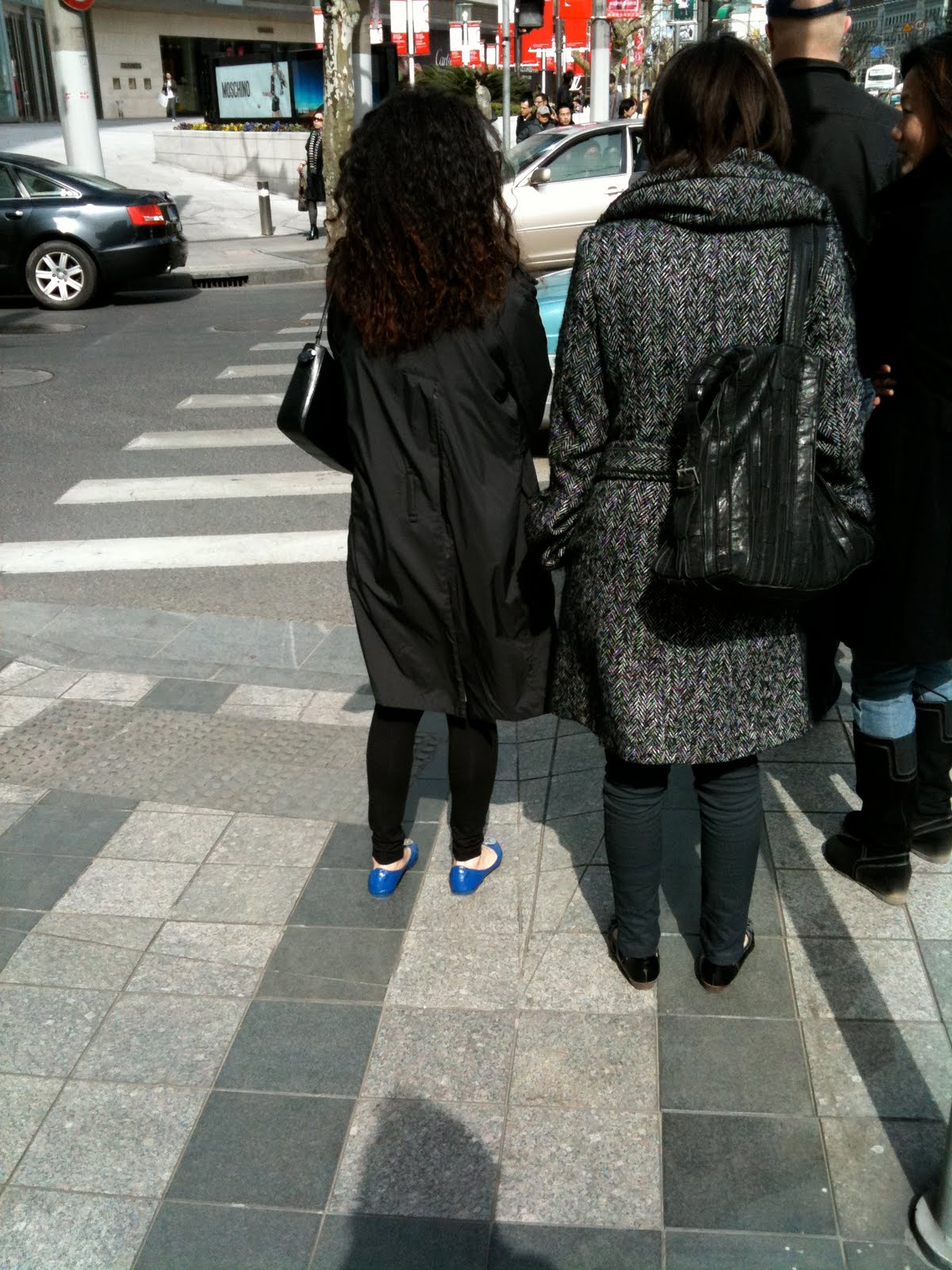
But maybe I'm giving Shanghai and the Language Monitor a rough time... I mean, there are certainly glimmers of style throughout this fantastic city, but the seasonal trend of rolling your shirt up over your beer belly to beat the summer heat has made me overall really skeptical of Shanghai's style potential. But here are a few springtime outfits I managed to snap while I still had an iPhone that make me still believe:


Monday, February 15, 2010

Enter: The Age of Modernity!

Wow, I'm the world's most delinquent blogger ever I think... but in China it's a New Lunar Year, and I resolve/PROMISE (yet again) that I'll be updating on a weekly basis.

Anyway, about Chinese New Year... IT'S 2010 OFFICIALLY on the East Side now, so let's finally bring about the important topic of modernity and how it is related to fashion (a hefty subject to say the least).

"Modernity", or modeng in Chinese, has historically been synonymous with Shanghai, while Beijing has played the traditional role in the dichotomy. It's easy to see in many ways how Shanghai represents the modern and how Beijing represents the traditional, but with specific regard to fashion, it is important to define and analyze what the Chinese population is interpreting as modernity, and thus, fashion.

To be truly modern in fashion is not to exercise exactly fashion, but to interpret it into a personal aesthetic (a style). Another key factor to being modern is a knowledge/understanding of the past so that one can deviate from it (before one can be truly separate from the past, which is non-dynamic, you have to know and understand it). It's more complicated than this, but I hope for now this makes sense.

Anyway, in the 1920s and 1930s in Shanghai, whatever was Western was automatically considered modeng... and I'd say that that simplistic yet foolish equation is used rather extensively today by a majority of the consumer population when trying to obtain so-called "modern fashion".

I can best illustrate this sad and pathetic yet all-too-common phenomenon of equating modernity with what is simply Western with two sets of pictures juxtaposing/contrasting different generations. You see, the problem with young people today is that they only want to be modern, which means rejecting the past before they understand it (I'm guessing for most people that is inconspicuous/homogeneous Communist/Chinesey uniform-esque clothing) and embracing only the Western. Old people, it seems, are content with interpreting their sartorial "references" (another important topic), and have interpreted/adapted/referenced past clothing practices for current use.

Also to note, because Western clothing culture is so new, clothing culture in China is based on the most basic, boring, and OLDDDDDDD Western "styles", and the consumption focus has become largely based on the "peripheral" (meaning accessories). So, in layman's terms, Chinese people (younger generations particularly) wear boring Western clothes and pair it with some terribly gaudy or conspicuous accessory and then... VOILA! They think that they are Western thus modern thus stylish.............

So anyway, enough theory and on to the evidence... or pictures:

These clothes are a terrible fit, and they are the boringest or boring shapes/colors/cuts in Western culture... but the Louis Vuitton bag saves it!


This man, on the other hand, is definitely stylin'... He has a strong sense of self portrayed through his clothing, and has not a single logo that disrupts or dominates his interesting composition. The colors are balanced and even pop a bit, and his hat, glasses, and shoes all add quite a bit of character, while gently referencing some sort of romanticized archetype of an old, dapper Shanghai-er.. appropriately contextualized on the Bund by the way:

And oh my goodness... if this 年轻人 (nianqingren or young-ish person) approaching me in this photograph is a manifestation of sartorial "modernity" in China, then kill me now cause there is no reason to live in the future:


I mean, do I really have to say anything about this guy and why I prefer his personal aesthetic/style to the mindless fashion consumption of the younger generations?


So ironically, I would say that older generations that experienced Communist China under Mao actually have a better sense of personal style... or at least, it is better communicated in today's society; furthermore, in an international sense, I would argue that these two older gentlemen demonstrate a sensibility for style that the young people don't. I would say this because in an international context, fashion is understood through its history (again, it constantly references the past in order to deviate from it), and people that use their personal experiences to create an aesthetic are going to contribute much more to China's fashion culture than the mindless drones that are being brainwashed to consume these terrible, TERRIBLE, TERRIBLEEEEEEEE monogram bags.

Wednesday, December 30, 2009

Sniped Shanghai Street Shots: Top 9 of '09

I've had three obstacles thus far in putting together a Top 9 of '09 list like this (I kind of did it):

1 - I've only been in China for 12 weeks and thus don't have that many great pictures to choose from.
2 - I've literally been sniping shots (stealing you could say perhaps) of people on the streets because no one will ever pose when I ask them... they are highly suspicious of us foreign folk, which has made it difficult to get perfectly posed pictures.
3 - I'm usually trying to take pictures as inconspicuously as possible while walking on the street, riding the bus, in a cab, or on my roommate's scooter. So please, if the pictures are off-centered or blurry, don't judge me... the pictures are ranked by considering both the subject's style/stance and the quality of the photo.

...So I've finally edited it down to the Top 9, but this post might spoil some later posts because the pictures are released before they are really contextualized. But it's the New Year soon, so there are many, many new pictures to be sniped of otherwise unwilling subjects, but just to forewarn, you will see some of these pictures again.

Honorable Mention - She would have made it into the Top 9, but I spotted a Burberry scarf in her outfit unfortunately. But I know that it's at least real because it's not conspicuously the central piece of her look. Rather, it's blended as a part of a beautiful composition, and I have to give her props for making the world's single most offensive piece of clothing almost bearable:

Number 9 - This guy really isn't Number 9... I just thought I should start off the list with a strong and interesting look to entice you to read further, and this guy has style to the max. His layers are great, the colors are beautiful, and the composition is perfectly and quirkily accented by the silly shape and color of the hat:


Number 8 - Jean jackets are back! Or rather, they never cycled out of the Chinese fashion system. We are still a couple of decades behind here, so I could understand one or two jean jackets here or there. But there are MANY, and they are EVERYWHERE (as I'll blog about later). What's worse is that jean jackets are inevitably paired with, how creative!, jeans. But he looks like a working boy, as he's obviously a bit tired, so his jean suit is probably uber functional:


Number 7 - Here's a construction worker with a loosely tailored and semi-disheveled look that I thought was super cool. If you were working as a construction worker, wouldn't you want to still achieve some amount of individuality from the billions and billions of other construction workers in China?? I've never seen an anyone in such a profession in China so interestingly dressed, but the proportions, colors, cuts, and styling are all there. Appropriate, but still exceptional:

Number 6 - I love the conspicuousness of this woman's PJ set... I never knew a pink to pop like that, and what makes this particular ensemble even more special are the heeled boots and cell phone she's sporting around with her stroller:

Number 5 - So poised, yet not posed... this young gentleman has interesting layers and proportions, as well as nicely composed colors.

Number 4 - I always find people on the street wearing super interesting uniforms... an interesting factoid when you consider the country's recent sartorial history. Anyway, this maiden clad in all white gets the Number 4 spot for her cute haircut and incredulous stare:

Number 3 - This little girl is ColorBlocking my brains out! She deserves Number 3 all to herself for how cool she looks (and the pose I got was great!), but I'm adding another little girl's picture right below just for some contrast... I bet the ColorBlocker didn't dress herself that way, but at least someone in her family had the decency to not dress the little girl in a fake Burberry coat at the tender age of 5:


Number 2 - This old guy has the most endearing smile, and I somehow managed to capture it... and this close up to him too! The iPhone has revolutionized picture/video-taking, because I would never have been able to have gotten this close to someone and sniped this kind of a shot with a regular camera. Anyway, I love his sweater pattern and color combination on top, and he's dressed appropriately for his age. His personality though definitely is what makes the picture Number 2:

Number 1 - She's the coolest f'in lady I've seen in China. I ran across the street and almost died to get this photo, but it was well worth it. She's super unique and quirky by Chinese standards definitely, but she's just chillin' and doing her own thing with that bright blue bow tie. I think she was as intrigued by me as I was by her, which allowed me to snipe this great shot and expression:

Sunday, October 25, 2009

From Clothing to Fashion to Style

The fastest way I can explain the differences amongst these three words, or concepts, is that clothing is the most basic form and style is the most advanced.

Clothing in theory only existed when pieces of clothing were used strictly for the function of modesty or protection (depending on whether or not your viewpoint is religious). Today, since each piece of clothing is loaded with signifiers and connotations and meaning, no person uses "clothing." For everyone dressing in today's world, clothing is fashion, but there are those that have progressed to practicing style.

The largest percentage of style-practicing citizens are from the West (where exactly, that can be debated), but I would argue that China is perhaps at one of the lowest percentages in terms of population that practices style.

This is for a couple of reasons. One is because sartorial practices are based mainly on imitation of Western fashion. Imitation is certainly part of fashion, but individuality is key in practicing style. The organic growth of fashion into the mature form of style is hampered by large Western fashion brands, whose voyeuristic imagery have helped fuel the trend of imitation instead of individualization... although unattainable by many because of high prices, it still serves as a homogenizing form for China's richest. And for the rest of the population, fashion arbitration and dissemination comes from a foreign source, meaning that China can only truly develop style once it adapts, as opposed to adopts, cultural materials like fashion.
Related Posts with Thumbnails

ShareThis